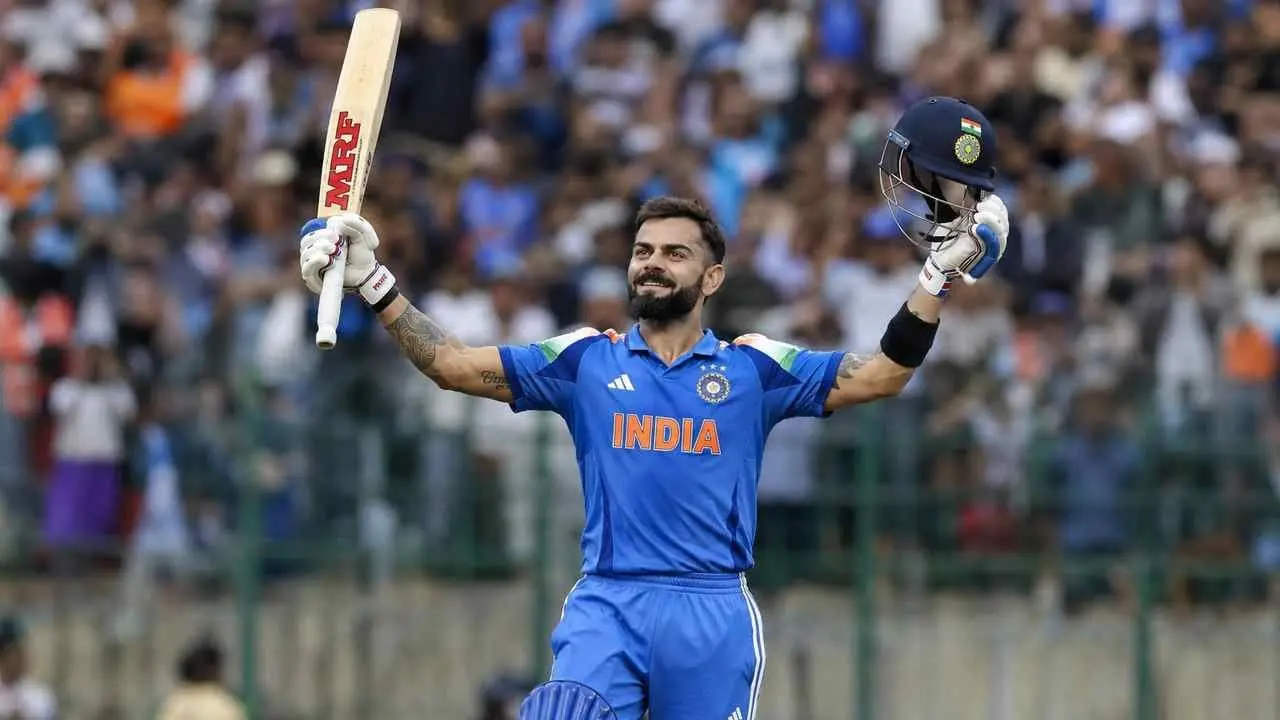
Kohli’s brilliant batting helped India beat New Zealand in the first ODI at Eden Park. But simply calling him the match’s highest scorer does not fully explain the quality of his innings.
On a pitch where batters from both teams struggled with movement and bounce, Kohli looked as though he was batting on a different surface. His timing, shot selection and control turned a difficult challenge into a batting masterclass.
He smashed 74 runs from 51 balls at a strike rate of 145.10. On a surface that repeatedly tested the other batters, he scored at a pace that made the chase look far more comfortable than the conditions suggested.
The real significance of that innings becomes clear when you look beyond the scorecard.
Why Chasing at Eden Park Was Such a Tough Challenge
Eden Park’s short boundaries can be misleading. A small ground does not automatically mean an easy batting surface, particularly when the pitch offers seam movement and steep bounce.
In those conditions under lights, back-of-a-length deliveries become especially demanding. Batters have to judge how much the ball will move off the surface and how sharply it will climb. Committing too early can produce an edge, while misjudging the bounce can lead to a mistimed attacking shot.
That makes it difficult to attack freely, even when the boundaries are within reach. The batter needs the technique to handle the movement and the control to keep shorter deliveries down or hit them into gaps.

The previous two completed men’s ODIs at Eden Park showed how quickly a chase could collapse.
| Match | First-innings score | Chasing team’s score |
|---|---|---|
| Sri Lanka vs New Zealand, January 2025 | Sri Lanka: 290/8 | New Zealand: 150 all out |
| New Zealand vs Sri Lanka, March 2023 | New Zealand: 274 all out | Sri Lanka: 76 all out |
The previous two chasing totals were just 150 and 76. Even New Zealand, familiar with their home conditions, had been bowled out for 150 while pursuing 291.
India initially needed 186 after dismissing New Zealand for 185—a target higher than either of those teams had managed in their chases. Rain later reduced the requirement to 143 from 32 overs, and India reached 143/5 in 22.4 overs to win by five wickets.
Those earlier matches were played on different days, but they explain why Eden Park’s boundary dimensions alone could not make this chase straightforward.
Kohli Dominated the Deliveries That Troubled Everyone Else
The biggest difference appeared against back-of-a-length and shorter deliveries.
These were the lengths that brought the surface’s bounce into play and repeatedly challenged the batters. Bowlers could force mistakes without having to offer full deliveries in the hitting zone.
But the same approach produced dramatically different results against Kohli.
| Against back-of-a-length or shorter deliveries | Balls faced | Runs | Strike rate | Dismissals |
|---|---|---|---|---|
| Virat Kohli | 25 | 43 | 172 | 0 |
| All other batters combined | 138 | 91 | 65.94 | 6 |
The other batters collectively scored 91 runs from 138 balls against those lengths and lost six wickets. Their scoring rate was approximately 66 runs per 100 deliveries.
Kohli scored 43 from just 25 balls at a strike rate of 172, without being dismissed by those deliveries.
He was scoring more than two and a half times as quickly against the very lengths that were causing problems for everyone else.
His 43 runs included seven fours and a six, with 34 runs coming through boundaries. He was not merely getting through the difficult deliveries. He was attacking them successfully.
That is the most powerful illustration of his innings: the bowlers’ biggest weapon against the other batters became a scoring opportunity against Kohli.

Why His 74 Was Far More Valuable Than It Looked
On a batting-friendly surface, predictable bounce gives batters the freedom to commit to their shots. A pitch offering movement and extra bounce demands much finer judgement.
Kohli showed that judgement throughout his innings. He did not have to wait for a stream of full balls to maintain his scoring rate. His ability to score against shorter bowling allowed him to keep India moving despite the challenge posed by the surface.
The contrast was striking. While other batters struggled to score against those lengths without losing their wickets, Kohli found boundaries and put pressure back on the bowlers.
His overall strike rate was 145.10. Against back-of-a-length and shorter deliveries, it climbed to 172.
That is why this innings deserves to be assessed through the conditions and the opposition’s methods, rather than the total alone. His 74 was the match’s highest score, but the way he made those runs was even more impressive.
Virat Kohli Becomes the Only Batter to Average Above 50 in All Four SENA Countries
The innings also brought another remarkable achievement. Virat Kohli became the only batter in the world to have an ODI batting average above 50 in each of the four SENA countries—South Africa, England, New Zealand and Australia.
Before the series, Kohli had scored 596 ODI runs in New Zealand with 12 dismissals, averaging 49.66. His 74 took his tally to 670 runs from 13 dismissals, lifting his average to 51.53.
| Country | Kohli’s ODI batting average |
|---|---|
| South Africa | 76.38 |
| England | 51.48 |
| New Zealand, after this innings | 51.53 |
| Australia | 50.03 |
For a batter who developed in Asian conditions, maintaining an average above 50 in all four countries is an extraordinary demonstration of adaptability. Different pitches, different bowling attacks and different challenges—yet Kohli has delivered across them all.
His Eden Park masterclass showed exactly why. On a surface where movement and bounce troubled other batters, Kohli found a way to dominate.
First Batter to Reach 13,000 ODI Runs at No. 3
During the same innings, Kohli also became the first batter in world cricket to complete 13,000 ODI runs at No. 3.
It added another milestone to an innings already defined by its quality. His record at No. 3 reflects years of consistency, while his performance against New Zealand showed how he continues to produce runs in demanding conditions.
No praise will ever be enough for this masterclass from Kohli. All hail the brilliance of King Kohli!