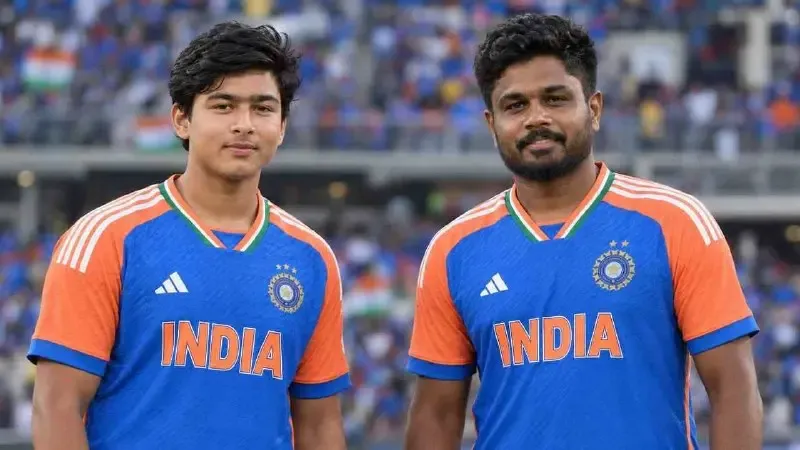
Sanju Samson has become a constant talking point in Indian cricket. He performs, people discuss him. He fails, people discuss him again. His talent has never been the real question. The question is how long that talent can justify repeated failures while a generational talent like Vaibhav Sooryavanshi waits outside the playing XI.
India’s continued backing of Samson is now hurting both the team and Sooryavanshi’s opportunities. Three important World Cup knocks deserve lasting appreciation. They should not become a permanent pass into the team, regardless of what follows.
Sanju Samson’s Form Raises a Bigger Question
The New Zealand series was supposed to test Samson in challenging conditions. His opening-match fifty offered hope that he was finally building consistency. It was a convincing, chance-free innings—the clearest example since the World Cup of Samson looking fully in control.
But four successive failures followed. Once the surfaces offered movement or extra bounce, the same concerns returned.
The criticism goes beyond a few low scores. Samson’s performances since the World Cup point towards a dependence on favourable batting conditions. When the ball moves, climbs sharply, turns or holds in the surface, his effectiveness drops.
An international opener cannot depend on everything being in his favour. India need someone who can respond when the pitch asks difficult questions, especially when another talented opener is waiting for a proper run.
What Happened Across the Different Series?
Ireland offered bounce and some movement. Samson struggled. England brought another test against bounce, and he again failed to make a meaningful impact.
Then came Afghanistan on surfaces offering very little assistance to the bowlers. Samson produced two good innings. However, one also involved a dropped catch. That matters when assessing how convincing those performances actually were.
The Japan match and Asian Games presented a different challenge. The ball gripped, turned and did not arrive comfortably onto the bat. Samson again struggled to impose himself, with particularly slow innings adding to the concern.
Against West Indies, the conditions swung back towards the batters. These were games in which totals around 250 were being scored and chased. Samson delivered two half-centuries, but one of those innings included two dropped catches.
A dropped catch does not erase the runs that follow. But it does matter when the argument for continued selection rests on a handful of successful innings. Some of those performances came on excellent batting surfaces and still required chances from the opposition.
Even on tracks where ordinary batters could find consistency, Samson was not delivering regularly.
New Zealand’s opening match briefly suggested that the pattern might change. The next four innings brought the debate straight back.
Vaibhav Sooryavanshi Has Answered Tougher Questions
Sooryavanshi’s first England tour did not go well either. That is part of the comparison and should not be ignored.
What followed, however, makes his continued wait difficult to justify.
In Zimbabwe, the ball was holding in the pitch. Abhishek Sharma and other Indian batters struggled to find their rhythm. Sooryavanshi stepped up in those conditions and finished as Player of the Series. His contributions were important enough that, without them, India could have been in danger of losing a match or two.
At the Asian Games, he again showed his value on a two-paced surface. His innings against Sri Lanka was a quality, match-winning contribution. Against Pakistan, he also provided a strong start.
These performances matter because they came when batting was not straightforward. He was finding ways to contribute rather than waiting for a perfect surface.
Yet he has not received a sustained run on the kind of batting tracks that have helped Samson produce his better innings.
Limited Chances, Immediate Impact
Sooryavanshi received two opportunities in New Zealand. Even those should not simply be grouped together as easy batting conditions.
In one match, the ball held in the surface and fluent attacking batting was difficult. Tilak Varma accelerated towards the end, but the conditions had restricted the other batters.
On the more favourable surface, Sooryavanshi immediately showed his attacking range with 45 runs off 19 balls. His IPL performances had already demonstrated the damage he could do when conditions allowed him to play freely.
That creates an uncomfortable selection question. Why does Samson keep receiving opportunities to find consistency while Sooryavanshi has to prove himself through scattered appearances?
One player continues to receive backing after failures. The other produces important contributions and still finds himself waiting.
World Cup Gratitude Cannot Decide Every Selection
Samson’s three World Cup knocks should always be valued. Nothing in this criticism takes away their importance.
But gratitude and current selection are separate matters.
India cannot keep selecting a player because of what he delivered in one tournament while overlooking the pattern that has developed since. If an opener succeeds once or twice in five matches, and some of those innings depend on dropped catches, the team must question whether that is enough.
The concern is sharper when his strongest returns largely come on surfaces offering little help to the bowlers.
Sooryavanshi has shown that he can contribute when the ball grips or the pitch behaves unevenly. He has also shown how destructive he can be on a good batting surface. That combination deserves a proper opportunity.
Play Sooryavanshi or Release Him to Play Domestic Cricket
Keeping Sooryavanshi with India without giving him regular matches carries its own cost. He is in form and needs competitive cricket to maintain that rhythm.
Repeatedly sitting out can affect confidence. It also takes away time that could be spent facing bowlers, adjusting to conditions and developing through actual match situations.
If India cannot give him a place, they should release him to play domestic cricket. Keeping him involved in matches is more useful than leaving him on the bench while the same selection cycle continues.
The management must now make a clear decision: give Sooryavanshi a sustained run, or explain why Samson’s repeated failures still deserve priority. India’s trust cannot remain an endless safety net for one player while another player’s opportunities disappear.