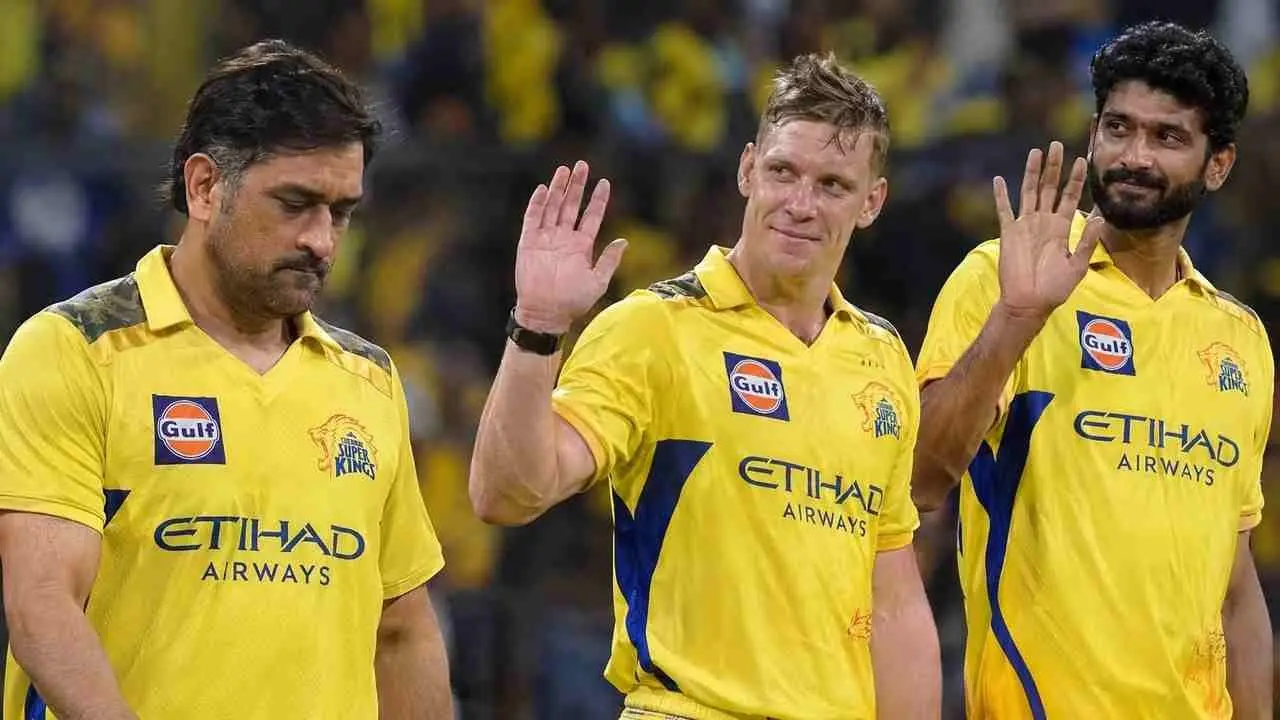
Chennai Super Kings, considered one of the smartest and most successful franchises in the IPL, look unsettled by their disappointing performances in recent years. Their latest four-player trade with Sunrisers Hyderabad is a shocking decision that has weakened their own team.
CSK have brought in Liam Livingstone and Jack Edwards while giving away Nathan Ellis and Khaleel Ahmed. The problem is straightforward: they have surrendered two valuable specialist fast bowlers for two all-rounders whose places and impact in the playing XI are far less certain.
Why Losing Nathan Ellis Is CSK’s Biggest Mistake
Ellis missed IPL 2026 because of injury. When fit, however, he would be a first-choice selection in this attack. His ability to handle the death overs makes him especially difficult to replace.
He has the variations and yorkers needed to challenge batters on flat pitches. When the surface offers little assistance, changing pace and hitting the blockhole become crucial. Ellis brings both skills, along with experience delivering for Australia and in franchise cricket.
That is why letting him go for just ₹2 crore makes so little cricketing sense. CSK had a specialist capable of handling some of the toughest overs at a bargain price. They have now handed that advantage to a direct opponent.
Our valuation of a fit Ellis at auction would be at least ₹7–8 crore. Replacing him with a premium overseas fast bowler could push Chennai towards the ₹10 crore bracket. But CSK’s problem goes beyond money. Bowlers of Ellis and Khaleel’s quality are difficult to find in a mini-auction, where the supply of proven talent is limited. Chennai could end up spending a large chunk of their purse on an average replacement simply because better options are unavailable. They have given away valuable specialists at affordable prices and now face paying much more for less quality.
Khaleel Ahmed’s Exit Creates Another Hole
Khaleel offered a different skill: the ability to make an impact with the new ball. His performances are not extraordinary every time, and trading him alone would have been easier to understand. Even so, he remains a valuable Indian left-arm pace option.
Quality Indian left-arm fast bowlers are difficult to find. That scarcity makes Khaleel worth more than a simple reading of his ₹4.8 crore fee suggests. He could command a higher price if several franchises competed for him at auction.
Together, Khaleel and Ellis offered two distinct roles—new-ball threat and death-over control. Both would have been first-choice options in our assessment of CSK’s strongest XI when fit.
Anshul Kamboj and Jamie Overton remain important, but Chennai have removed a major part of their attack’s strength. They now need to rebuild the pace department instead of strengthening an existing combination.
Where Does Jack Edwards Fit?
Livingstone appears to be the main target of this deal. Bringing his fee down from ₹13 crore to ₹6 crore is a positive piece of negotiation. The bigger question is whether taking Edwards alongside him actually improves CSK’s strongest team.
Consider the likely overseas combination:
| Overseas slot | Player | Main role |
|---|---|---|
| 1 | Dewald Brevis | Specialist batter |
| 2 | Jamie Overton | Pace-bowling all-rounder |
| 3 | Liam Livingstone | Batting all-rounder |
| 4 | Noor Ahmad | Specialist spinner |
Brevis and Overton would be automatic selections in this combination. If Livingstone takes the third spot and Noor the fourth, there is no room for Edwards.
Spencer Johnson would also be outside that XI. If Chennai leave out Noor, their weakened pace attack creates a strong reason to use that overseas place on a specialist fast bowler. Edwards would still struggle to find a clear route into the side.
CSK have therefore traded away two players with clear first-XI roles while bringing in an overseas all-rounder who looks more like a reserve.
Livingstone’s Recent Form Does Not Justify the Sacrifice
Livingstone is no longer delivering the consistency that made him such an attractive middle-order player at his best. His ability to attack spin consistently is a particular concern in assessing his suitability for Indian conditions.
His recent IPL returns underline the problem. He scored 112 runs at a strike rate of 133.33 for RCB in 2025, before the franchise released him. At SRH in 2026, he managed 15 runs in two matches and lost his place.
This is not a player arriving after two strong seasons. Chennai are buying into the hope that he can recover his best form.
The concern is that CSK may also have to drop him midway through the season if those problems continue. With Edwards already facing a difficult selection battle, Chennai could end up with neither incoming player providing a settled first-XI solution.
That is a poor exchange for specialist skills that are much harder to replace at auction. A lower purchase price for Livingstone does not automatically make the overall trade good value.
Why Prioritise All-Rounders Under the Impact Player Rule?
The Impact Player rule reduces the need to select an all-rounder simply to balance batting and bowling. Teams can bring in an additional specialist batter or bowler according to the stage of the match.
An all-rounder still needs to offer enough quality in a primary role to justify selection. Being able to contribute a little with both bat and ball does not automatically make a player more valuable than a specialist match-winner.
That is the central flaw in this trade. CSK have prioritised two all-rounders with uncertain roles over a death-over specialist and an Indian new-ball bowler. They have strengthened SRH while leaving themselves to search for the skills they already possessed.
CSK’s Updated Squad Picture After the Trade
The following groups show Chennai’s existing player pool with Livingstone and Edwards added and Ellis and Khaleel removed. The final IPL 2027 retained squad is still to be announced; players signed as injury replacements in 2026 are identified separately within each group.
Overseas players: Dewald Brevis, Jamie Overton, Noor Ahmad, Liam Livingstone, Jack Edwards, Akeal Hosein, Matthew Short, Matt Henry and Zakary Foulkes. 2026 injury-replacement signings: Spencer Johnson and Dian Forrester.
Indian players: Ruturaj Gaikwad, MS Dhoni, Sanju Samson, Ayush Mhatre, Urvil Patel, Kartik Sharma, Sarfaraz Khan, Shivam Dube, Prashant Veer, Aman Khan, Ramakrishna Ghosh, Anshul Kamboj, Gurjapneet Singh, Mukesh Choudhary, Rahul Chahar and Shreyas Gopal. 2026 injury-replacement signings: Akash Madhwal, Kuldip Yadav and Macneil Noronha.