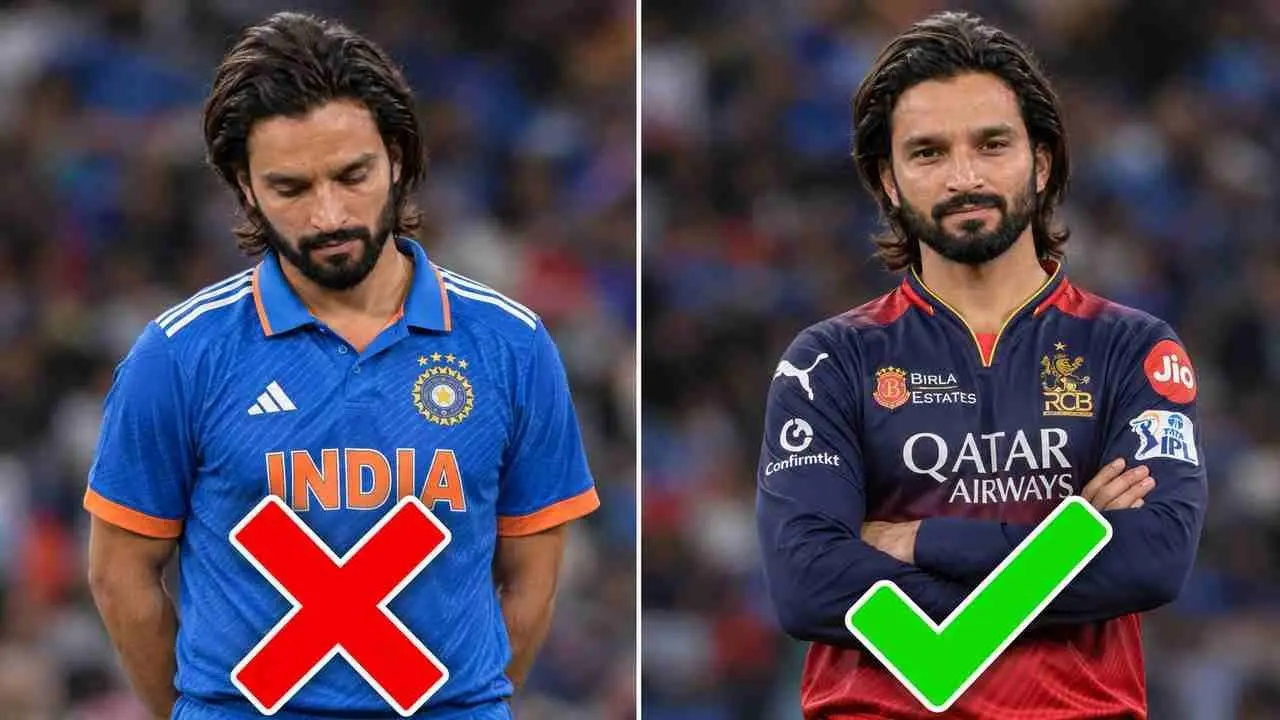
Rajat Patidar has surprised everyone with his own decision today. He was selected for India A’s Rising Stars Asia Cup squad, and people expected him to strengthen his Team India claim with a strong performance. With age not on his side, this was an opportunity to impress the selectors and put pressure on them through runs.
Several cricketers have used India A opportunities to push their way into the senior team. But Patidar has taken a different route. By withdrawing from this tournament while preparing for domestic T20 cricket, he has put his India ODI ambitions on the line—a choice that directly benefits his preparation for RCB.
Let us look at how.
Why Rajat Patidar withdrew from the Asia Cup
Patidar informed the BCCI that he should not be considered for selection in the 50-over format while managing his existing injuries. Following his withdrawal, Ayush Badoni has joined the squad, while Rinku Singh has been appointed vice-captain.
But there is an important detail here. Patidar has also been named Madhya Pradesh captain for the Syed Mushtaq Ali Trophy. He has recently played four-day cricket in the Ranji Trophy and for India A against Australia A.

His recent participation does not erase the BCCI’s injury explanation. It does, however, make his choice of format the central issue. He is stepping away from an India A assignment in 50-over cricket while preparing to lead his state in T20 cricket.
That choice comes with a clear cost: he loses an opportunity to strengthen his case for India’s ODI team.
Why the decision benefits RCB
At 33, Patidar does not have unlimited time to wait for an international comeback. Breaking into India’s ODI batting order before the 2027 World Cup looks difficult. During the next World Cup cycle, his age will make that challenge even greater.
RCB offers him a much clearer future. His role is established, he has the responsibility of captaincy, and the franchise has backed his talent.
Focusing on T20 cricket therefore offers an immediate return. He can work on the batting approach, scoring options and leadership decisions that he will need in the IPL instead of switching to a format where his international prospects remain uncertain.
This is the strongest explanation for the RCB angle: Patidar’s decision keeps him in the format that matters most to his franchise career, even though it costs him an India A opportunity.
The tournament clash makes his priorities clearer
The Syed Mushtaq Ali Trophy begins on November 14. The Rising Stars Asia Cup will take place from November 19 to 29.
Had Patidar travelled with India A, he would have missed a substantial part of Madhya Pradesh’s T20 league campaign. Those matches determine qualification for the next stage, and his absence would also have required a change in captaincy.
Staying with Madhya Pradesh gives him the opportunity to lead throughout that period and build continuity in T20 cricket.
That continuity can benefit RCB. Rather than moving between formats, he can spend this stretch developing the same skills he will need as an IPL batter and captain. Strong domestic performances could also help him push for an India T20 opportunity.
He is effectively investing in the format where he has a secure franchise role and a possible international route, while surrendering a chance in the format where his future looks less certain.
Selectors are not fools—they can see the priorities
The selectors are not fools. They can see Patidar’s recent participation in longer-format cricket, his appointment as Madhya Pradesh’s T20 captain and his withdrawal from the India A assignment.
The injury-management explanation is on record. So is the consequence of his decision: an opportunity to represent India A has been given up while his T20 campaign remains the priority.
That is why this move points towards prioritising IPL preparation over his India ODI ambitions. Whatever his intentions, he will not be scoring runs in this tournament to strengthen his case before the selectors. Another player now gets that opportunity.
For someone already fighting to return to the senior team, giving up such a platform is a significant gamble.
Backing the team that has backed him
There is also a cricketing frustration behind this argument. Patidar’s strong performances have not always translated into the India opportunities he would have wanted. RCB, meanwhile, has given him a prominent role and the responsibility of leading the team.
The appeal is obvious: focus on a side where his place and value are established instead of chasing an uncertain ODI opening.
But that choice carries responsibility. If Patidar is concentrating his efforts on T20 cricket, he now needs performances that justify it—for Madhya Pradesh, for RCB and potentially for an India T20 place.
The next test is whether those returns outweigh the India A opportunity he has surrendered.