
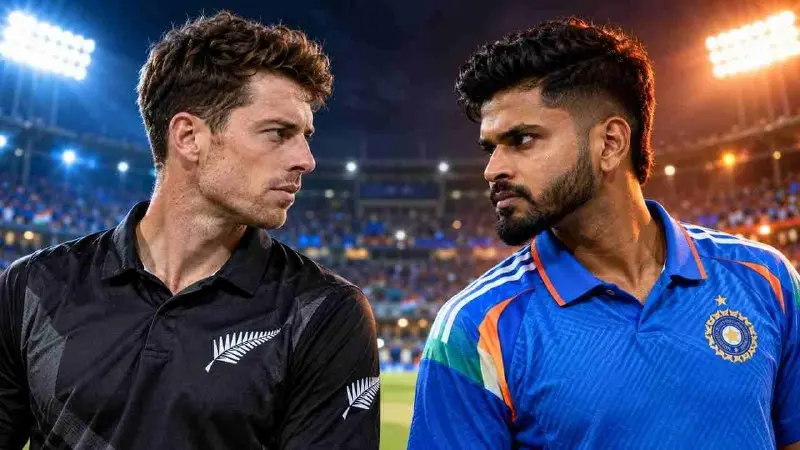
The India vs New Zealand series is about to begin, and the rivalry already has an extra edge. After losing the T20 World Cup final to India, New Zealand now have a chance to settle the score at home. Before the first ball, Jacob Duffy’s comments have raised a question India cannot ignore: could this tour bring back the problems they faced in England?
New Zealand’s players usually let their performances do the talking. Duffy, however, has made his excitement about facing India in home conditions clear. His remarks about the pitches, boundaries and expected scores amount to an indirect challenge to India’s batters—and the technique behind their attacking game.
Jacob Duffy Warning: Prove It in Our Conditions
Duffy said his recent encounters with India had all come in Indian conditions. Now, he is looking forward to playing them in New Zealand, where the hosts feel more comfortable. He also revealed that his friend Jaden, the Hagley Oval groundsman, had promised some bounce.
That matters immediately because Hagley will host the first two T20Is on October 22 and 24. India will begin the series facing the very conditions Duffy is eager to exploit.
The underlying challenge is sharp: scoring heavily at home is one thing; repeating it against extra bounce in unfamiliar conditions is another.
A pitch does not have to be difficult for batting to test technique. Even on a good surface, extra bounce can force a batter to change a shot at the last moment. Getting into position, judging the length and controlling the ball become crucial. An attacking approach that works comfortably on flatter pitches can quickly unravel when those adjustments are missing.
Hagley’s bigger boundaries increase that risk. Mistimed pulls and lofted shots will not necessarily carry for six; they could land in a fielder’s hands. This is why Duffy’s confidence reads as more than a comment about home advantage. It puts India’s ability to score outside their comfort zone under scrutiny.
An Indirect Dig at Indian Pitches
Duffy reinforced that contrast when discussing possible totals. He said he hoped teams would not score 250, joking that it would damage his bowling figures. Instead, he suggested that scores around 170–200 could be more typical at Hagley, calling it “old-school T20 cricket.”
Duffy’s remarks about bigger boundaries, extra bounce and lower scores were an indirect dig at India’s batting-friendly pitches. The question is whether the same batters can remain dominant when bowlers have more room to attack and mishits are punished.
India may therefore need more than clean hitting. When boundaries become harder to find, rotating the strike and building partnerships must keep the innings moving. The real examination will be whether their batters recognise that change quickly—or continue forcing shots until wickets fall.
England Showed Why India Should Take This Seriously
That concern comes from what happened in England, where India lost the T20I series 4–0. The hosts showed that runs were available, but India repeatedly struggled to adjust against pace and bounce.
Shreyas Iyer’s unbeaten 80 in the fourth T20I offered resistance, yet India finished with only 158 and lost by nine wickets. Ishan Kishan and Tilak Varma scored fifties in the final match, but those individual efforts could not prevent another defeat. India never found a collective batting response strong enough to change the series.
New Zealand now have an opportunity to attack the same weakness. If India’s batters misjudge the bounce or commit too early to their shots, the hosts have the pace options to keep them under pressure.
That makes the opening two matches in Christchurch an immediate test of what India learned in England. Duffy has backed the conditions to make a difference. India’s batters must now show that their attacking game can withstand it.
India T20I Squad
Shreyas Iyer (captain), Abhishek Sharma, Sanju Samson (wicketkeeper), Vaibhav Sooryavanshi, Ishan Kishan (wicketkeeper), Tilak Varma (vice-captain), Axar Patel, Shivam Dube, Nitish Kumar Reddy, Naman Dhir, Prince Yadav, Mayank Yadav, Arshdeep Singh, Bhuvneshwar Kumar, Varun Chakaravarthy and Kuldeep Yadav.
New Zealand T20I Squad
Mitchell Santner (captain), Finn Allen, Michael Bracewell, Josh Clarkson, Devon Conway, Jacob Duffy, Lockie Ferguson, Matt Henry, Bevon Jacobs, Kyle Jamieson, Adam Milne, Daryl Mitchell, Glenn Phillips, Tim Seifert, Nathan Smith and Blair Tickner.
Josh Clarkson and Blair Tickner replace the injured Mark Chapman and Zak Foulkes. Rachin Ravindra also misses the T20I series through injury.
Download the CricInformer app
Take CricInformer with you. Get our app for cricket news and updates on your phone.