
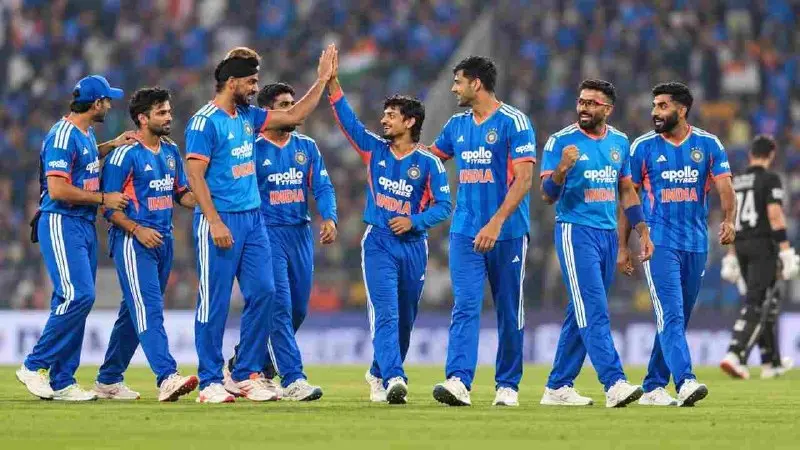
With the India vs New Zealand series just hours away, fans are busy discussing the playing XI. Will Vaibhav Sooryavanshi get an opportunity? Who will take the field for India, and which combination will New Zealand choose?
These teams met in the T20 World Cup final earlier this year, adding extra interest to their latest meeting. But for Indian fans, this series also brings a bigger question: has the team learned from its struggles overseas?
After the disappointing results in Ireland and England, India face another demanding assignment away from home. The first T20I at Hagley Oval, Christchurch, on October 22 will test their preparation against a strong New Zealand side.
CricInformer’s predicted combinations are outlined below; the official teams will be announced at the toss. One or two selections can still change, but the main combinations are taking shape.
Sooryavanshi’s Wait Continues as India Back Their Openers
Sanju Samson and Abhishek Sharma will open the batting in our combination, leaving Vaibhav Sooryavanshi on the bench again.
Captain Shreyas Iyer has backed the established opening pair because of their consistent performances. For the youngster, that means waiting for an opening despite the excitement surrounding his aggressive batting.
Ishan Kishan will bat at No. 3, followed by Iyer at No. 4 and Tilak Varma at No. 5. This gives India an attacking top order, but handling the moving ball will be an important part of their responsibility in Christchurch.
Dube and Nitish Give India Additional Seam Options
The change comes in the middle and lower order, with Naman Dhir making way for a combination that includes both Shivam Dube and Nitish Kumar Reddy.
Dube and Nitish will provide batting power alongside additional seam-bowling options. Their presence gives Iyer greater flexibility to use pace when conditions offer assistance without sacrificing batting depth.
Axar Patel will strengthen the lower order and provide left-arm spin, while Varun Chakaravarthy will bring his variations into the middle overs.
Bhuvneshwar Kumar and Arshdeep Singh will handle the specialist pace-bowling duties. Bhuvneshwar’s ability to swing the new ball makes him particularly important in conditions where early movement can put the opposition under pressure.
New Zealand Combine Batting Depth With a Strong Pace Attack
Finn Allen and Tim Seifert will open for New Zealand in our combination. Allen’s attacking approach will be important in the powerplay, while Seifert will also keep wickets.
With Rachin Ravindra absent from the squad, Devon Conway will bat at No. 3. Glenn Phillips and Daryl Mitchell will follow, giving the middle order power and experience.
Michael Bracewell and captain Mitchell Santner will add batting depth and spin options. Their all-round contributions give New Zealand flexibility when deciding how to use their specialist bowlers.
Nathan Smith will add another seam-bowling option and lower-order batting depth. Kyle Jamieson or Adam Milne will take the remaining pace position alongside Matt Henry and Lockie Ferguson.
Jamieson offers height and bounce, while Milne brings extra pace. The surface will help determine which of those qualities New Zealand prioritise.
India vs New Zealand 1st T20I Playing11
| No. | India | New Zealand |
|---|---|---|
| 1 | Abhishek Sharma | Finn Allen |
| 2 | Sanju Samson (wk) | Tim Seifert (wk) |
| 3 | Ishan Kishan | Devon Conway |
| 4 | Shreyas Iyer (c) | Glenn Phillips |
| 5 | Tilak Varma | Daryl Mitchell |
| 6 | Shivam Dube | Michael Bracewell |
| 7 | Nitish Kumar Reddy | Mitchell Santner (c) |
| 8 | Axar Patel | Nathan Smith |
| 9 | Bhuvneshwar Kumar | Kyle Jamieson / Adam Milne |
| 10 | Varun Chakaravarthy | Matt Henry |
| 11 | Arshdeep Singh | Lockie Ferguson |
Hagley Oval Pitch Report: Pace and Bounce to Test India
Hagley Oval is expected to provide a balanced contest, with opportunities for batters and assistance for pace bowlers. Extra bounce and movement will make this a different challenge from the highly batting-friendly surfaces seen recently in India.
The larger boundaries will also test shot selection. Batters will need to judge the bounce carefully and time their attacking shots, rather than rely only on power.
Jacob Duffy has suggested scores around 170–200, rather than the 250-plus totals seen on some Indian grounds. His assessment points towards a contest where bowlers have a greater opportunity to influence the game.
For India, the challenge will be to maintain their attacking intent while adapting to those conditions. Handling the new ball, building partnerships when needed and using their own seam options effectively will be central to their performance.
Download the CricInformer app
Take CricInformer with you. Get our app for cricket news and updates on your phone.