
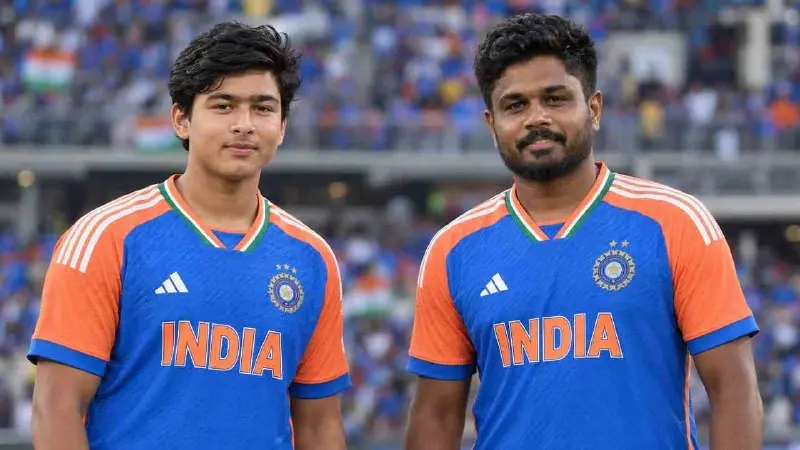
India need Vaibhav Sooryavanshi ahead of Sanju Samson at the top of the order. That is the selection call this team should make—and the reason goes beyond one explosive innings.
Samson is unfortunate to face this competition while scoring runs himself. But India’s priority must be selecting the batter who can do more damage in the same number of deliveries. Vaibhav’s scoring speed, IPL consistency and powerplay potential make a compelling case.
His 45 off 19 balls against New Zealand in Wellington showed exactly what India gain by opening with him alongside Abhishek Sharma. He missed his fifty, but his innings had already helped change the match.
Six Overs That Showed What India Could Gain
Vaibhav and Abhishek attacked together from the start. India reached 50 in 14 balls, 100 in 30 balls and 118/0 after six overs.
That opening burst equalled the fastest team fifty in men’s T20Is, produced the fastest team hundred by a Full Member nation and established a new men’s T20I powerplay record.
| Milestone | India’s performance | Record |
|---|---|---|
| Team fifty | 14 balls | Joint-fastest in men’s T20Is |
| Team hundred | 30 balls | Fastest by a Full Member nation |
| Powerplay total | 118/0 | Highest in men’s T20Is |
Vaibhav contributed 44 off 17 balls inside the powerplay, while Abhishek scored 67 off 20. Both ends were producing boundaries. New Zealand could not escape the pressure by getting one opener off strike.
Samson and Abhishek have delivered aggressive starts too. The argument for Vaibhav is that his scoring ceiling can take those starts further. Wellington demonstrated what that extra gear looks like.
Vaibhav’s IPL Numbers Combine Speed With Consistency
Calling Vaibhav merely an attacking option misses half the story. His IPL 2026 season combined exceptional scoring speed with a strong average.
| Vaibhav’s IPL 2026 performance | Figure |
|---|---|
| Matches | 16 |
| Runs | 776 |
| Batting average | 48.50 |
| Strike rate | 237.30 |
An average of 48.50 alongside a strike rate of 237.30 is the strongest answer to the suggestion that selecting him means sacrificing consistency for aggression.
India should want both. Vaibhav has already shown that he can score heavily while maintaining a tempo that forces opponents to change their plans.
Vaibhav vs Samson: How Quickly Can They Reach Fifty?
The speed of an innings matters enormously when an opener has only six overs of fielding restrictions to exploit.
Vaibhav has already reached an IPL fifty in 15 balls, compared with Samson’s 19-ball IPL best. In T20 internationals, Vaibhav’s 18-ball fifty against Zimbabwe is quicker than Samson’s 20-ball best.
| Benchmark | Vaibhav Sooryavanshi | Sanju Samson |
|---|---|---|
| Fastest IPL fifty | 15 balls | 19 balls |
| Fastest T20I fifty | 18 balls | 20 balls |
Vaibhav has also produced multiple rapid IPL half-centuries, including 15- and 16-ball efforts. Outside T20 cricket, his 11-ball List A fifty against Sri Lanka A offers another example of how quickly he can overwhelm an attack.
These are different formats, but the underlying skill is the same: he needs very little time to make a major impact.
The century comparison reinforces that attacking potential. Vaibhav reached his maiden IPL hundred against Gujarat Titans in 35 balls in 2025, showing that his acceleration can continue well beyond fifty.
A Few Deliveries Can Change the Powerplay
Suppose one opener reaches fifty in 19 balls and another needs 25. Both have scored the same runs, but the first has left six additional deliveries for the team to use.
At Vaibhav’s attacking tempo, those deliveries can produce another 15–20 runs. That is an illustration of the opportunity, rather than a guaranteed return, but it explains why India must value scoring speed alongside runs.
Wellington offered a practical example. Vaibhav did not need a personal milestone to make his innings valuable. His 45 came at a strike rate of 236.84, and his partnership with Abhishek reached 133 before the first wicket fell.
Waiting for a fifty to recognise that contribution would miss the point. He had already given India a huge advantage.
Why Vaibhav Deserves Backing on Difficult Pitches Too
The case for Vaibhav also rests on backing his attacking method when conditions become harder.
On a slower or two-paced pitch, he may not reproduce his best scoring rate every time. But his ability to manufacture boundaries can still turn a short innings into a match-winning contribution. His performances against Zimbabwe and Sri Lanka at the Asian Games show why that potential deserves investment.
Samson’s vulnerability when pace bowlers find movement or the surface slows down remains a concern in this selection argument. The preference for Vaibhav is that he offers a greater chance of breaking those difficult passages through aggression.
That does not mean predicting a Samson failure or a Vaibhav success before every match. It means choosing the batter whose strengths better fit the attacking cricket India want to play.
India Must Choose the Greater Powerplay Threat
Samson can score runs and still lose this selection contest. With Abhishek Sharma, Ishan Kishan and Vaibhav competing for top-order opportunities, being in form does not automatically make a player the best option for a particular role.
For the opening position alongside Abhishek, Vaibhav offers the stronger attacking proposition. His IPL season supplies the consistency argument, his rapid fifties demonstrate the scoring speed, and Wellington shows the partnership’s potential.
India should give that combination a sustained run. Selecting Vaibhav allows the team to pursue the extra powerplay runs his game is built to produce.
Download the CricInformer app
Take CricInformer with you. Get our app for cricket news and updates on your phone.